zzvf | Nicknames and Stage Names (1)

In this column: nicknames, stage names, Chicago Bob Nelson, Howlin' Wolf, Mance Lipscomb, Muddy Waters, Jimmy Rogers, Speckled Red, Pine Top Smith, Pine Top Sparks, Pine Top Perkins, Lindberg Sparks, Tampa Red, Homesick James, Big Bill Broonzy

Introduction

It's an interesting topic to figure out why blues musicians have adopted or been given different names over time. An obvious reason is because their real name is not considered appealing enough and a made-up name is more noticeable to the public. The stage name.
Artists have also taken names from their youth or acquired names that can be traced back to physical characteristics or striking talents.

Chester Arthur "Howlin' Wolf" Burnett; the name "Howlin' Wolf" originated from Burnett's maternal grandfather, John Jones, Burnett had been squeezing his grandmother's chicks so hard he was likely to kill them, and his grandfather told him wolves would come and get him.

Howlin’ Wolf – Down in the Bottom

Chicago Bob Nelson

I once discussed this with Robert Lee Nelson (blues singer and harmonica player) during a European tour. He said that Muddy Waters gave him the name "Chicago Bob" because at the time he followed Muddy everywhere he played in Chicago. He hoped Muddy asked him to play. Coincidentally, I have a CD on which Muddy announces Chicago Bob (and Little Billy Boy, Billy Boy Arnold) to play on the song "Goin' Back Home".
Bob didn't think I should attach too much importance to it, nicknames were mainly invented for fun. If I lived in America, I'm sure they would have called me "Wooden Shoe Johnny." Nicknames are sometimes given to you in life. "Inventiveness with language is an integral part of being a blues musician because they’re creative people who have fun with words.” (Tim Duffy, Music Maker Relief Foundation)

Chicago Bob and Muddy Waters

Muddy announces Chicago Bob (and Little Billy Boy, Billy Boy Arnold) to play on the song “Goin’ Back Home”

Chicago Bob and Tony Bryant – One of these days

Blues is a feeling

Originally, songs were sung in family settings about struggle and perseverance, with which people could identify. When they started performing in front of a larger and unknown audience, they wanted to maintain the intimacy of the family home. By using a nickname, they could temporarily evoke the intimate feeling that comes with a blues performance. "Blues is a feeling".

Beau De Glen "Mance" Lipscomb and family (photo Mack McCormick). As a youth, Lipscomb chose the name "Mance" (short for emancipation).

Mance lipscomb – Nighttime is the right time

Names with an origin in childhood

McKinley "Muddy Waters" Morganfield's grandmother called him "Muddy" because he loved to play in the muddy water of a stream, later when he played the blues he added "Waters".
Everyone knows examples of special names that people call each other in small communities and family homes. My mother was raised in a large family, where all siblings had nicknames. They chose names based on appearance, behavior or a notable incident.
Nicknames have often become so well known that people no longer know the real name. That is certainly the case with Muddy.
Jay/James Arthur Lane took his stepfather's surname and came up with the stage name Jimmy Rogers.

James Lane a.k.a. Jimmy Rogers
Rufus "Speckled Red" Perryman; he was the older brother of Piano Red. Their nicknames were derived from both men being albinos. Barrelhouse pianist.

Jimmy Rogers – Walking by myself (1985, with James Cotton and Pinetop Perkins)

Speckled Red – The right string, but the wrong yo-yo

The Pine Tops

Clarence "Pine Top" Smith
His grandmother gave him the name because he used to climb pine trees a lot as a child.
Aaron "Pine Top" Sparks
Pinetop got his nickname from playing Pinetop Smith's hit "Pine Top"s Boogie Woogie".
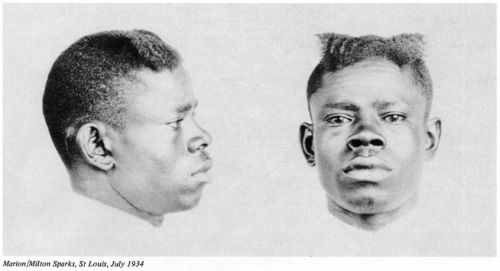
Aaron had a twin brother Milton/Marion "Lindberg" Sparks. Marion called himself Lindberg because he could really dance the Lindy Hop! This dance, named after the aviator Charles Lindberg.
They did not have steady employment and frequently had run-ins with the law. Pinetop drank heavily, and Lindberg killed a man (in self-defense), for which he spent time in the workhouse in 1937.
Pinetop died, apparently of poisoning, in 1935.
Joe Willie "Pine Top" Perkins
Perkins recorded "Pinetop's Boogie Woogie" at Sam Phillips's Sun Studio in Memphis, Tennessee. The tune was written by Pinetop Smith, who created the original recording in 1928. He learned to play-off Smith's records. As Perkins recalled, "They used to call me "Pinetop, because I played that song."

Pine Top Smith
Lindberg Sparks
Pine Top Perkins

Pine Top Smith – Pine Top’s Boogie Woogie (1929)

NOTE

Pinetop Smith (24) and Sparks (25) both died violent deaths at a very young age, Smith had been shot and Sparks was poisoned by bad liquor.

Names related to the family

Families were often torn apart because parents married at a very young age or because the father left the family to look for work elsewhere, leaving his family in poverty. The children could then be placed with their grandparents or relatives. It then happens that the children took over the name of their mother, grandmother, uncle or stepfather. Blues musicians took this name with them in their later careers.

Whittaker/Woodbridge

Hudson Whittaker (born Hudson Woodbridge) known as "Tampa Red" was raised in Tampa (Florida) by his aunt and grandmother and adopted their surname, Whittaker. He adopted the name "Tampa Red" with reference to his childhood and his light-colored skin.

Tampa Red

Tampa Red and Georgia Tom – It’s tight like that (1928)

Homesick James

John William Henderson, better known as “Homesick” James Williamson; the son of Cordellia Henderson and Plez Williamson Rivers, his first known recordings were in 1952 for Chance Records, recording the tracks “Lonesome Ole Train” and “Homesick”, which gave him his stage name.

Left > right: Sunnyland Slim, Homesick James, Elmore James (Homesick claimed that Elmore was his nephew)

Homesick James + Aces and Roosevelt Sykes – Working With Homesick (I Got To Move) 1970 France

Big Bill Broonzy

William Lee Conley "Big Bill" Broonzy (born Lee Conley Bradley); Broonzy was not his real name, he was born Lee Conly (note spelling) Bradley, his first name was Lee. It is uncertain whether his father's name was Broonzy or Bradley. More about Broonzy in a next episode.

Big Bill Broonzy (1951)

Big Bill Broonzy 1957: “Worried Man Blues,” “Hey, Hey” and “How You Want It Done.”