zzux | Nicknames and stage names (8)

In this column: nicknames, stage names, Mickey Guitar Baker, Guitar Shorty, Guitar Slim, Earl King, Eddie "Guitar" Burns, John Lee Hooker, BJ Hegen Blues Band, Guitar Nubbit, Matt Guitar Murphy, Memphis Slim, The Blues Brothers, Washboard Sam, Harmonica Shah, Howard Glazer

Introduction

Stage names based on the instrument.

MacHouston "Mickey Guitar Baker"
Baker was an American guitarist, best known for his work as a studio musician and as part of the recording duo Mickey & Sylvia.
In new York, Baker began recording for Savoy, King and Atlantic Records. He did sessions with Doc Pomus, The Drifters, Ray Charles, Ivory Joe Hunter, Ruth Brown, Big Joe Turner, Louis Jordan, Coleman Hawkins, Dion and numerous other artists. Inspired by the success of Les Paul & Mary Ford, he formed the pop duo Mickey & Sylvia (with Sylvia Robinson, one of his guitar students) in the mid-1950s. In 1959, Baker released his debut solo album, The Wildest Guitar, on Atlantic. Around 1960 he moved to France, and would remain there for the rest of his life. Baker wrote an influential series of guitar tutor books.

Mickey Baker – Sweetie Cat and Don’t Try To Play Me For A Clown (1973)

David William "Guitar Shorty" Kearney
Kearney was an American blues guitarist and singer-songwriter. He was known for his guitar style. He was inspired by Jimi Hendrix and Buddy Guy.

Personal Note
I met Guitar Shorty in France when our band Chicago Bob accompanied on an European tour. He was flown in from the United States and because his flight was delayed, he had to be picked up from the airport at very short notice. The Otis Grand Blues Band, who played after us, had to fill the time until he arrived. The band came straight from Switzerland and band members were very tired. Otis asked us to fill in for a moment so that the drummer, bassist and he could take a break. He gave me his guitar. During our fill-in, Shorty came on stage with an armful of effects pedals, settled in and started "Hey Joe". After a number of sung verses, he started to solo, stepped off the stage and then walked around the entire hall with a dancing footstep. We lost him for a while, but soon saw him passing by across the balcony. It was hilarious and a moment I will never forget.
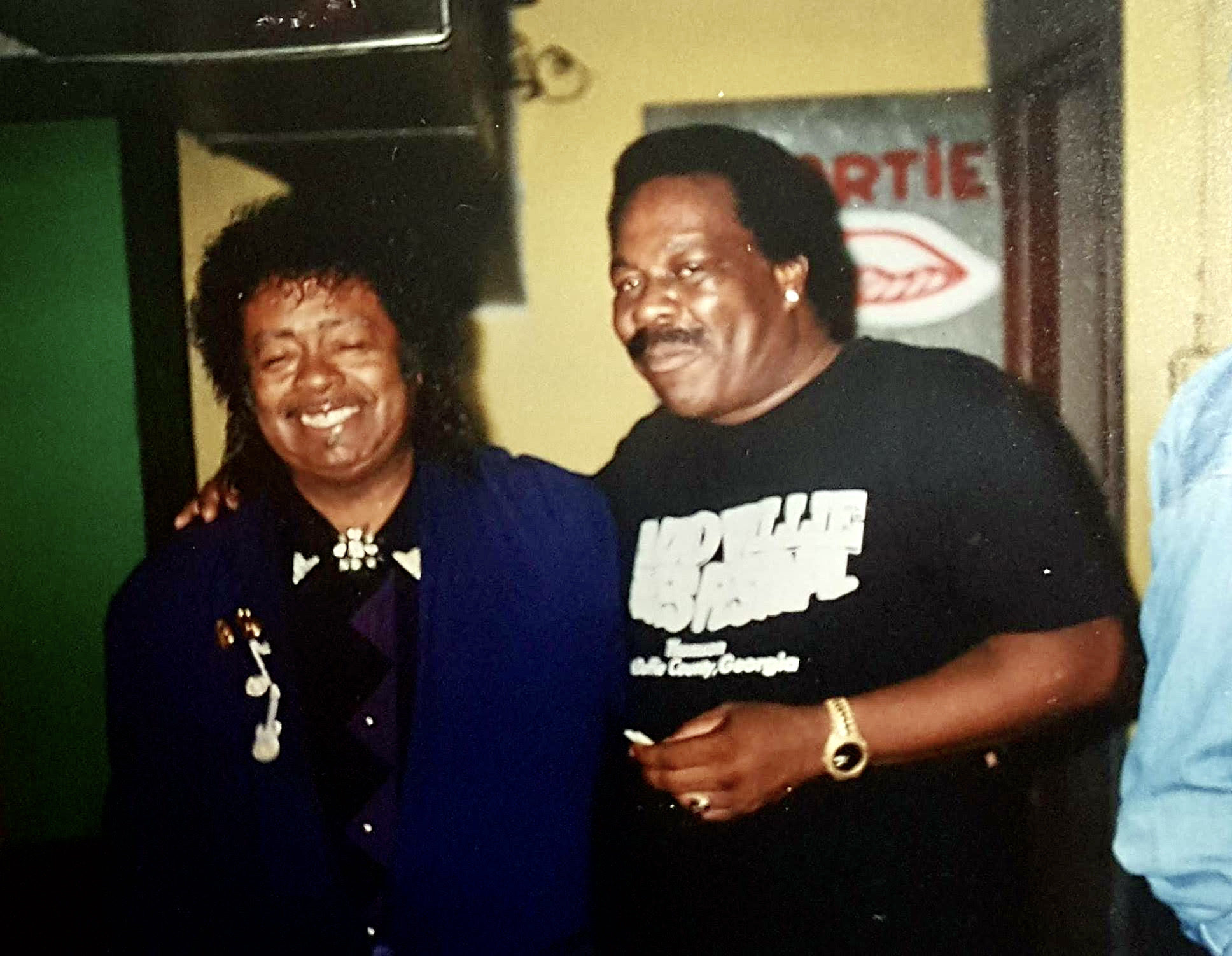
Guitar Shorty and Chicago Bob (1994, Sarreguemines Nuit du Blues)

Guitar Shorty – Hey Joe (Lucerne, 16/11/2012)

Eddie "Guitar Slim" Jones
Jones was an American guitarist in the 1940s and 1950s, best known for the million-selling song "The Things That I Used to Do".
About 1950 he adopted the stage name Guitar Slim and became known for his wild stage act. He wore bright-colored suits and dyed his hair to match them. He had an assistant who followed him around the audience with up to 350 feet of cord between his guitar and his amplifier. His sound was just as unusual—he played his guitar with distortion more than a decade before rock guitarists did.
Guitar Slim died far too soon at the age of 32 from pneumonia.

Guitar Slim – The Story Of My Life (1954)

Earl King Gives a Beautiful Performance of “The Things That I Used to Do”

Eddie "Guitar" Burns
Eddie Burns was an American Detroit blues guitarist, harmonica player, and singer and songwriter. Among Detroit bluesmen, Burns was deemed to have been exceeded in stature by only John Lee Hooker.
Billed as Big Daddy, Little Eddie, or Big Ed, he performed regularly in Detroit nightclubs but had to supplement his earnings by working as a mechanic. In 1966 he was billed as Eddie "Guitar" Burns on Hooker's album The Real Folk Blues. In 1972, Burns undertook a European tour and recorded his debut album "Bottle Up & Go" in London, both organized by Jim Simpson of Big Bear Records, who was the first to insert the epithet "guitar" into Burns's name.
His brother Jimmy Burns is a soul blues musician who lives in Chicago and played guitar on Burns's 2002 album Snake Eyes.

Eddie Burns (harmonica) and John Lee Hooker (guitar) – Where Did You Stay Last Night (1951)

Eddie ‘guitar’ Burns and BJ Hegen Blues Band – The blues is allright (1987, live at cafe De Sleutel Groningen)

The above recording was for a local radio station in Groningen (the announcer is Koos Huizenga): Eddie 'guitar' Burns (vocal, guitar), Will Drenth (drums), Cynthio Ooms (bass), Eric Zuidema (guitar), Jon Morris (bluesharp), BJ Hegen (ill that day)

Alvin "Guitar Nubbit" Hankerson
Hankerson was an American blues guitarist and singer. His most notable song was "Georgia Chain Gang". Henderson was born in Fort Lauderdale, Florida. During a hurricane when he was three years old, he lost the tip of his right thumb, which led to his lifelong nickname, Nubbit (sometimes shortened to Nub).

Guitar Nubbit – Georgia Chain Gang (1962)

Matthew Tyler "Matt Guitar" Murphy
Murphy was an American blues guitarist. He was associated with Memphis Slim, The Blues Brothers and Howlin' Wolf.
In 1952, Murphy recorded with Little Junior Parker and Ike Turner, resulting in the release, “You’re My Angel”/“Bad Women, Bad Whiskey”, credited to Little Junior Parker and the Blue Flames. Murphy worked often with Memphis Slim, including on his debut album At the Gate of Horn (1959). Murphy recorded two albums and many singles with Chuck Berry and was also featured in works by Koko Taylor, Sonny Boy Williamson II, Buddy Guy, Etta James, and Otis Rush. In the 1970s, Murphy associated with harmonica player James Cotton, recording over six albums. Murphy appeared in the films The Blues Brothers (1980, Dan Aykroyd and John Belushi) and Blues Brothers 2000 (1998). He performed with the Blues Brothers Band until the early 2000s.

Memphis Slim & Matt Murphy – Matt’s Guitar Blues (1963)

The Blues Brothers – Shotgun Blues (Live at the RR Convention, LA, 1979)

Robert Clifford "Washboard Sam" Brown
Sam was an American blues musician and singer. He moved to Memphis, Tennessee, in the 1920s, performing as a street musician with Sleepy John Estes and Hammie Nixon. He moved to Chicago in 1932, performing regularly with Broonzy (his half-brother) and other musicians, including Memphis Slim and Tampa Red. In 1935, he had become one of the most popular Chicago blues performers of the late 1930s and 1940s, selling numerous records and playing to packed audiences. He recorded over 160 tracks in those decades.

Washboard Sam – Diggin’ My Potatoes (1953, with Sunny Joe, Big Bill Broonzy)

Seward Daward "Harmonica Shah" (Born Thaddeus Louis Hall)
Shah is an American Detroit and electric blues harmonicist and singer.
Shah told Living Blues magazine that his grandfather's passion for the blues inspired him. "Well see I picked it up from him, he'd be out in the fields singin' all that (sings in a slow moan) 'Tell me how long, whoa, tell me how long it's been since you've been away from home' Well, that's raw! That's a big damn difference from 'Good Golly Miss Molly'".
He moved to Detroit in 1967, and worked for Ford Motors for fifteen years. Shah bought himself a cheap harmonica in 1976 and "Hell, that was it, no turning back then".
He has toured across the United States, as well as in Europe, Russia, Japan and Australia. Closer to his roots, Shah still occasionally performs for free at John's Carpet House in East Detroit.

Howard Glazer and Harmonica Shah (Live at Bert’s Warehouse & Entertainment Complex – Eastern Market, Detroit July 2013)

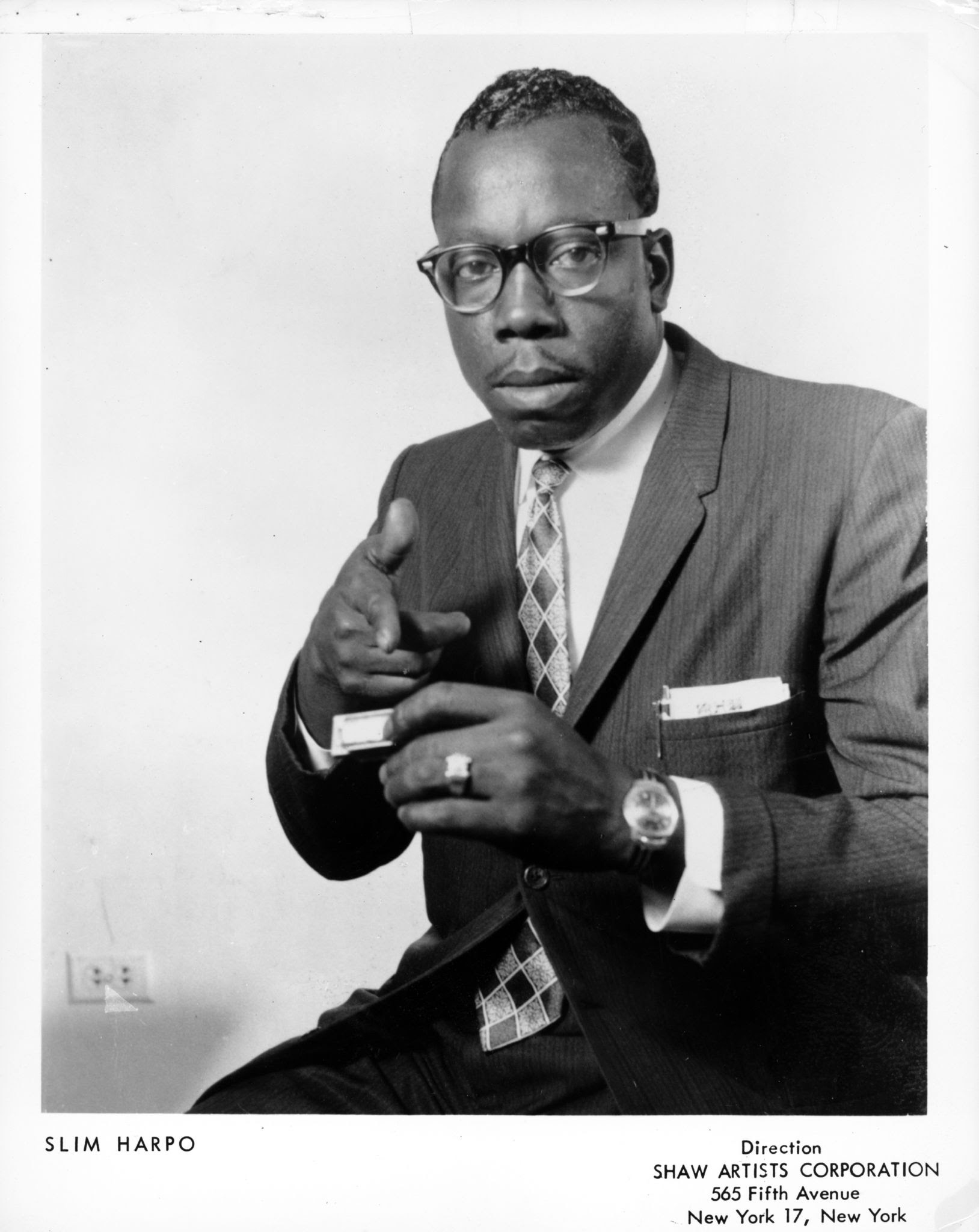
Slim Harpo (1960, photo Michael Ochs, see page stage names 4)